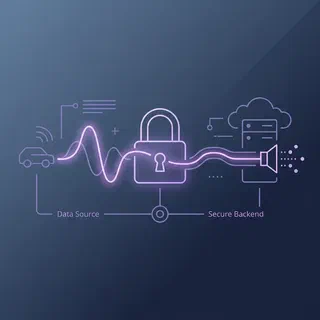
freematics-traccar-encrypted

freematics-traccar-encrypted (forked from the original project, now deleted from GitHub) is a custom firmware extension and intermediary proxy designed to secure telematics transmission between Freematics hardware trackers (such as Freematics ONE+) and a Traccar GPS server.
By default, Freematics devices stream vehicle telemetry and GPS data over unencrypted UDP channels because resource-constrained microcontrollers cannot handle the overhead of full TLS handshakes. This project resolves that gap by introducing a lightweight cryptography layer directly onto the device firmware and terminating it via a custom decryption proxy.
Architecture & Mechanics
- Firmware Encryption: Extends the Freematics
teleloggersketch with a fast, hardware-friendly symmetric encryption algorithm (ChaCha stream cipher) to secure UDP payloads before transmission. - Decryption Proxy: A lightweight intermediary service, written in Go, that listens for encrypted telematics packets from the tracker, validates payload integrity, decrypts the contents, and forwards standard unencrypted telematics records to the Traccar backend.
- Tamper Prevention: Protects location coordinates, speed, and OBD-II vehicle diagnostic data against passive eavesdropping and man-in-the-middle spoofing vectors.

About Me
Hi, I’m Florian Stosse, just another information security engineer !
Current work
I currently work at the European Space Agency, as a cybersecurity engineer for the Galileo programme, specifically for the Galileo Mission Segment (GMS).
Experience summary
I previously worked at Safran Data Systems, in the Space & Communications business unit. I focused on hardening and securing our embedded Windows 7 and 10/11 platforms (Cortex family of TT&C and high data rate receivers), among other cool things :)
Before that, in October 2018, I started a PhD thesis at CEA-List and ANSSI to work on formal methods applied to software security. More specifically, I was working on software defenses and hardening against hardware vulnerabilities, such as Spectre and Meltdown, using sound static analysis tools (Frama-C in particular).
My thesis was under the supervision of Julien Signoles (CEA), and my advisors were Patricia Mouy (ANSSI) and Florent Kirchner (CEA).
Unfortunately, we had to put a stop to the thesis, but hey, that’s life !
Education summary
I graduated with a M.Sc in Computer Science (major in cybersecurity, minor in embedded systems) from ESIEA Paris (a top French engineering school, part of the “Grandes écoles”) in August 2018. During my graduate studies, I was an apprentice at Bureau Veritas’ R&D center in La Défense, Paris.
I worked in the RAMS department, and my main areas of work were:
- software security (e.g. static analysis, SDLC),
- connected/autonomous vehicles security (e.g. ISO 21434 for automotive security engineering),
- and industrial systems security (e.g. ISO 62443 certification).
Do not hesitate to get in touch if you want to chat about these topics (or anything else, really) !